Search This Blog

Tuesday, February 3, 2026

Long Life vs Standard Radial Electrolytic Capacitors

SUNTAN TECHNOLOGY COMPANY LIMITED · ALL KINDS OF CAPACITORS

long life vs standard electrolytic capacitors

Long life vs standard radial electrolytic capacitors influences power supply lifetime, SMPS output stability, and LED driver reliability. Engineers evaluating an aluminum electrolytic capacitor must consider endurance hours, temperature rise, and ripple current stress together, as these factors define real operating life.


Understanding Electrolytic Capacitor Endurance Ratings

The endurance rating (2000h, 5000h, 10000h) indicates how long the capacitor maintains electrical characteristics at rated temperature and ripple current. As electrolyte evaporates over time, ESR increases and capacitance decreases, leading to ripple voltage rise and potential instability.

ClassEndurance @105°CTypical UsageExpected Duty
Standard2000hGeneral electronicsIntermittent
Long Life5000hLED drivers / controlsExtended use
High Endurance10000hSMPS / telecomContinuous

Temperature Acceleration Model

Electrolytic capacitor lifetime follows temperature acceleration behavior. Life approximately doubles for each 10°C drop in core temperature. Ripple current heating raises internal temperature above ambient, shortening effective endurance.

Lifetime estimation relationship:

L₂ = L₁ × 2((T₁ − T₂)/10)


Ripple Current Influence

Ripple current flowing through ESR generates internal heat (I²R loss). As ESR increases with aging, heating rises further, accelerating electrolyte dry-out in a feedback mechanism. This explains why SMPS output capacitors and LED driver capacitors require higher endurance classes.


Design Stage Selection Strategy

Engineers should base selection on:

  • RMS ripple current
  • Ambient and PCB thermal zones
  • Expected service life
  • Enclosure airflow

Field Failure Symptoms of Underrated Capacitors

When standard endurance capacitors are used in high ripple or high temperature environments, typical field symptoms appear gradually rather than as sudden failure.

  • Output ripple voltage increase
  • LED driver flicker over time
  • SMPS regulation instability
  • Rising ESR detected in maintenance testing
  • Reduced hold-up time in power supplies

These behaviors are wear-out mechanisms caused by electrolyte dry-out, not dielectric breakdown. Selecting long life capacitors prevents these progressive degradation issues.


Engineering Comparison

Parameter2000h5000h10000h
Electrolyte stabilityBaselineImprovedEnhanced
ESR driftFasterSlowerMinimal
Failure riskHigherModerateLowest

Official radial electrolytic capacitor endurance specifications available here.


Electrolytic capacitor endurance and temperature acceleration behavior are based on established reliability models used in power electronics design practice.

Tuesday, January 20, 2026

2016 vs 3215 vs 3225 SMD Quartz Crystal Comparison

SUNTAN TECHNOLOGY COMPANY LIMITED · ALL KINDS OF CAPACITORS

2016 vs 3215 vs 3225 SMD Quartz Crystal Comparison

When selecting an SMD quartz crystal, package size is often the first parameter engineers consider. However, choosing between 2016, 3215, and 3225 packages involves more than mechanical constraints alone. Electrical behavior, frequency range, and application requirements all play a critical role in effective SMD quartz crystal selection.

This article provides a practical SMD quartz crystal comparison to help engineers quickly determine which package is best suited for MCU clock crystal and RTC crystal 32.768kHz applications.

2016 vs 3215 vs 3225 SMD quartz crystal package comparison for MCU and RTC designs

Why Package Size Matters — and Why It’s Not Enough

Smaller SMD quartz crystal packages help reduce PCB footprint, but they typically introduce higher ESR and tighter oscillator startup margins. Larger packages generally provide improved oscillation stability and greater electrical tolerance. Understanding this trade-off is essential when comparing 2016 vs 3215 vs 3225 SMD quartz crystals.


2016 vs 3215 vs 3225: Key Differences

Package Typical Frequency Range Typical Application Design Consideration
2016 (2.0 × 1.6 mm) 20–54 MHz Compact MCU, wireless modules Higher ESR, reduced startup margin
3215 (3.2 × 1.5 mm) 32.768 kHz RTC, low-power timekeeping Tuning fork structure, ultra-low power
3225 (3.2 × 2.5 mm) 12–54 MHz Industrial MCU, control systems Lower ESR, stable oscillation

Which SMD Quartz Crystal Should You Choose?

For MCU clock crystal applications operating in the MHz range, the 3225 package is often preferred when PCB space allows, due to its lower ESR and more stable oscillator startup behavior.

The 2016 package is suitable for highly compact designs but requires careful validation of oscillator conditions, particularly in low-drive MCU circuits.

For real-time clock applications, the 3215 SMD quartz crystal is specifically designed for RTC crystal 32.768kHz operation and should not be substituted with general-purpose MCU crystals.


Video Reference: Visual Comparison of SMD Quartz Crystals

The following video provides a visual overview of SMD quartz crystal packages and their typical applications, helping engineers quickly identify physical differences between the 2016, 3215, and 3225 packages.


Explore SMD Quartz Crystal Options

To review detailed specifications or request application support, please visit the Suntan quartz crystal product pages or contact our technical team.

🔗 Explore SMD Quartz Crystal Products

📩 Contact Us for Application Support

Tuesday, January 6, 2026

Compact Polymer Aluminum Electrolytic Capacitors for Power Design | TS13

SUNTAN TECHNOLOGY COMPANY LIMITED · ALL KINDS OF CAPACITORS

In today’s power electronics, board space is often more limited than electrical margin. Compact power supplies, DC-DC converters, and high-density PCBs must balance performance, footprint, and sourcing stability.

TS13 polymer series overview for power supply and DC-DC applications.

Designers typically balance:

  • Electrical performance (low ESR, high ripple current)
  • Mechanical constraints (component height and footprint)
  • Assembly efficiency and sourcing stability
Video: TS13 polymer series overview

Design Challenges in High-Density Power Circuits

As power density increases, engineers frequently encounter:

  • Limited PCB area for bulk and output capacitors
  • Thermal constraints near switching devices
  • The need for stable performance across load variations
  • Pressure to control BOM cost without sacrificing reliability

Traditional electrolytic capacitors may struggle to meet ripple or ESR requirements, while premium polymer options can introduce cost and sourcing risks.


TS13 Polymer Series: Compact Solutions with Practical Performance

The Suntan TS13 Polymer Aluminum Electrolytic Capacitor series is designed to support compact power designs while maintaining balanced electrical performance and supply flexibility.

Rather than targeting only high-end applications, the TS13 series focuses on:

  • Practical form factors familiar to power designers
  • Competitive cost structure for volume production
  • Stable availability with flexible lead time and MOQ

Selecting the Right TS13 Model for Compact Power Design

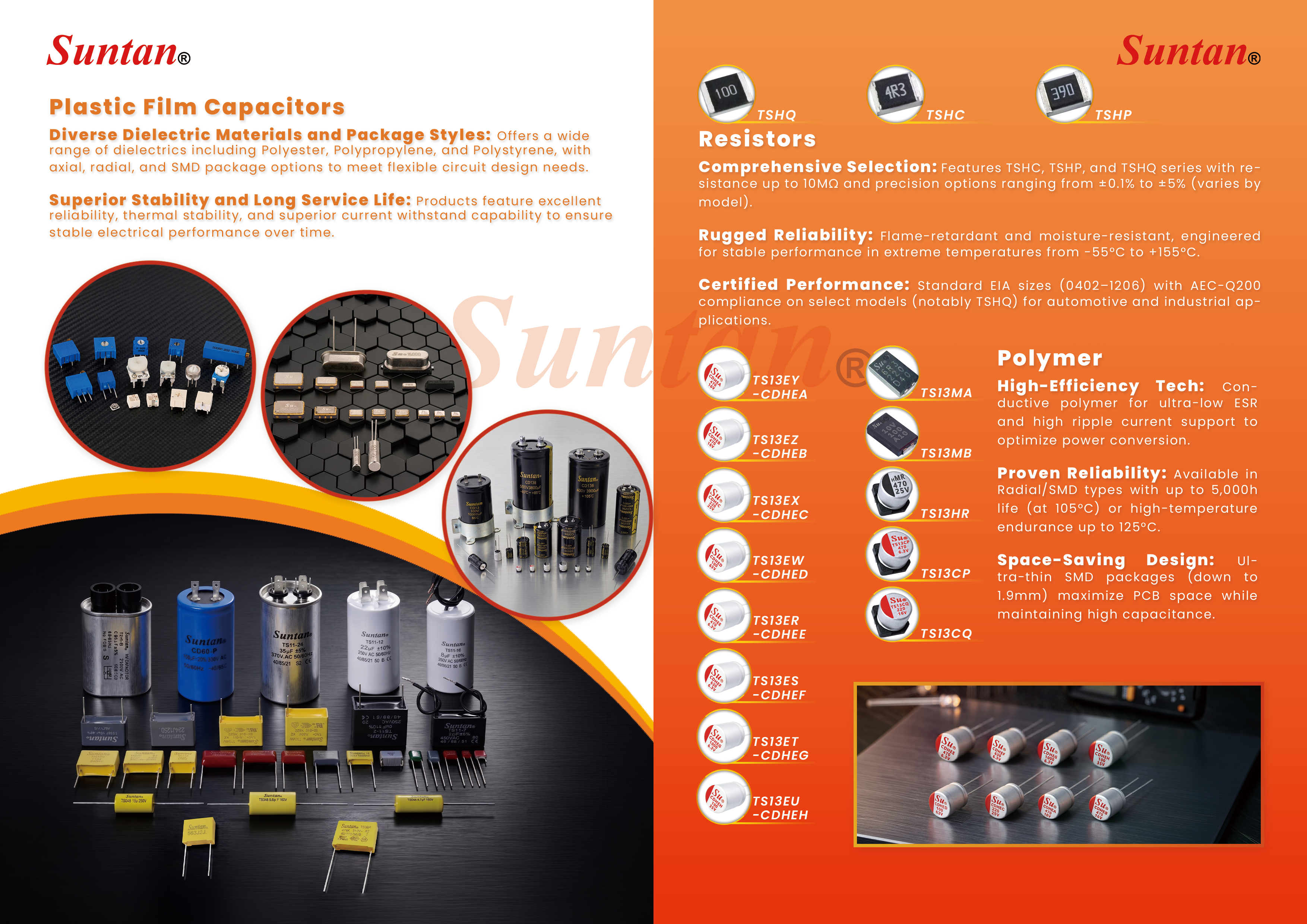
TS13CP: Compact SMD Polymer Capacitors for Space-Constrained PCBs

Designed for high-density layouts where footprint, ESR, and ripple performance matter.

  • Compact SMD package
  • Low ESR with high ripple current capability
  • Compatible with lead-free reflow soldering

TS13EY: Low ESR Polymer Capacitors for Efficient Power Conversion

Optimized for output stability and filtering in efficient DC-DC and power rail designs.

  • Super low ESR
  • High ripple current capability
  • Stable filtering performance

TS13EX: Compact Radial Polymer Capacitors for Thermal Stress Areas

Provides additional thermal margin with a category temperature rating up to 125°C.

  • Industrial power modules
  • Power stages near MOSFETs or regulators
  • Applications requiring long-term thermal stability

Compact Design Without Compromising Sourcing

Beyond electrical specifications, compact power designs often depend on supply chain predictability. The TS13 polymer series is positioned as a cost-effective, design-friendly alternative when projects require stable availability, MOQ flexibility for prototyping, and competitive pricing for volume builds.

Explore Compact Polymer Capacitors for Power Design

Review TS13 series options and move from evaluation to production with lower risk.

Monday, December 8, 2025

Why choose the TS04S Double-Sided Metallized Polypropylene Axial Capacitor Operates as a Non-Polar Film Capacitor

SUNTAN TECHNOLOGY COMPANY LIMITED · ALL KINDS OF CAPACITORS
Suntan TS04S double-sided metallized polypropylene film circular axial capacitor designed for high-voltage, low-loss power electronics applications
TS04S double-sided metallized polypropylene axial film capacitor for high-voltage, low-loss power electronics.

This guide explains why the TS04S double-sided metallized polypropylene axial capacitor behaves as a non-polar film capacitor and how it can be used safely in AC and pulse circuits. It is written for design engineers, distributors and OEMs who need reliable axial film capacitors for high-dielectric strength applications.

1. Why Non-Polar Axial Film Capacitors Matter

Polypropylene film capacitors with double-sided metallization, such as the TS04S, are inherently non-polar. The dielectric is an insulating polypropylene film, and the electrode layers are applied on both sides of the film, so there is no “positive” or “negative” terminal required for normal operation.

  • Support for AC and bidirectional pulse signals without reverse-voltage damage
  • Stable capacitance and low ESR over time
  • Reduced assembly errors and simplified PCB layout (no polarity marking required)
  • Long service life and strong thermal resilience compared with many electrolytics

In applications where the voltage reverses or the waveform is symmetrical (AC coupling, snubber networks, timing circuits), non-polar film capacitors like TS04S are a safer and more predictable choice than polarized capacitors.

2. Technical Advantages and Cross-Brand Compatibility

The TS04S series is available across a broad voltage range and multiple can sizes, which gives distributors and OEMs flexible stocking options and easier cross-reference mapping against other brands.

  • High-voltage PP axial options for demanding power electronics
  • Double-sided metallization supports controlled self-healing at localized faults
  • Low dielectric loss suitable for precision and high-frequency circuits
  • Cross-brand replacement lists and datasheets available for sourcing and qualification

For distributors, this means one TS04S family can cover multiple part numbers from other manufacturers, while maintaining consistent electrical performance and mechanical fit.

3. Applications Optimized for TS04S

Typical use cases where TS04S non-polar axial film capacitors are especially effective:

  • Timing circuits and pulse shaping where low loss and stable capacitance are critical
  • SMPS, LED drivers and inverters using high-voltage, high-frequency switching
  • AC filtering and snubber networks across relays, SCRs and power semiconductors
  • Precision and industrial-grade circuits requiring long-term stability and low drift

4. Recommended Video: Inside the TS04S

Engineering overview of the TS04S double-sided metallized polypropylene axial capacitor structure and how it achieves non-polar AC performance.
Explore TS04S drawings, voltage options and request samples:

Thursday, November 27, 2025

Why High-Voltage Circuits Prefer Polypropylene Film Capacitors — A Simple Guide to the TS09Q Series

SUNTAN TECHNOLOGY · FILM CAPACITOR ENGINEERING NOTES

A technical education guide for sourcing teams, component brokers and global distributors who need a reliable polypropylene film capacitor line for high-voltage applications.

Suntan TS09Q metallized polypropylene film capacitor for high-voltage filtering and SMPS applications
Suntan TS09Q High-Voltage Polypropylene Film Capacitor — official product image.

What Makes TS09Q Attractive to Distributors?

Unlike electrolytics, polypropylene film capacitors behave predictably under high voltage stress and temperature swings. For distributors, this means fewer returns, fewer cross-reference issues, and a smoother supply chain with repeatable performance across batches.

  • SMPS high-voltage DC filtering
  • Lighting ballasts and LED drivers
  • General HV buffering
  • Inductive load control

Its metallized polypropylene structure and controlled self-healing improve long-term reliability.

Product photo of Suntan TS09Q polypropylene film capacitor from official catalog
TS09Q Series – official catalog product appearance.

Voltage Range, Construction and Expected Lifetime

The TS09Q is rated 630V, 1000V and 2000V. Polypropylene film capacitors provide:

  • Low dielectric loss for HV filtering
  • Stable capacitance over temperature
  • Self-healing capability for fault isolation
  • Predictable ESR for SMPS power stages

These characteristics make cross-reference selection simpler for distributors.

Inside Suntan’s Film Capacitor Process

Inside Suntan’s film capacitor process — how stability and HV endurance are achieved.

When to Recommend TS09Q to Your Customers

Distributors can position the TS09Q as a stable, HV-capable substitute when customers need:

  • Long service lifetime
  • Heat-resistant PP structure
  • Low-loss filtering at high voltage
  • Stable supply with competitive MOQ
Check voltage options, dimensions and complete specifications:

Tuesday, November 18, 2025

6×6mm vs Vertical Tactile Switch|Quick Selection Guide

SUNTAN TECHNOLOGY · FILM CAPACITOR ENGINEERING NOTES

TS09Q 630V–2000V Film Capacitor Guide for Distributors

A technical education guide for sourcing teams, component brokers and global distributors who need a reliable polypropylene film capacitor line for high-voltage applications.

Main image of Suntan TS09Q metallized polypropylene film capacitor for high-voltage filtering and SMPS applications
Suntan TS09Q high-voltage polypropylene film capacitor – official product image.
Scope: This note focuses on TS09Q metallized polypropylene film capacitors in the 630V, 1000V and 2000V range, from a distributor and cross-reference perspective. Detailed electrical curves and derating data should be taken from the official datasheet.

1. What Makes TS09Q Attractive to Distributors?

Unlike electrolytics, polypropylene film capacitors behave predictably under high voltage stress and temperature swings. For distributors, this means fewer returns, fewer cross-reference issues, and a smoother supply chain with repeatable performance across batches.

  • SMPS high-voltage DC filtering
  • Lighting ballasts and LED drivers
  • General HV buffering
  • Inductive load control

The TS09Q uses a metallized polypropylene structure with controlled self-healing, improving long-term reliability in demanding power designs.

2. Voltage Range, Construction and Expected Lifetime

The TS09Q is available in 630V, 1000V and 2000V versions. Polypropylene film capacitors in this range typically provide:

  • Low dielectric loss for high-voltage filtering stages
  • Stable capacitance over a wide temperature window
  • Self-healing capability that localizes faults and preserves service life
  • Predictable ESR for SMPS power stages and snubber positions

These characteristics make cross-reference work easier for distributors – part selection is more about case size and lead spacing, less about unexpected drift or failure modes.

3. Mechanical Outline and Product Appearance

Product photo of Suntan TS09Q polypropylene film capacitor from official catalog
TS09Q series – official catalog product appearance for easy visual cross-reference.

From a stocking perspective, TS09Q keeps a standardized box-film outline with straight leads, making it a practical fit for:

  • General-purpose HV filter positions on through-hole PCBs
  • Retrofit of legacy box-film capacitors with similar pitch
  • Compact SMPS boards that still rely on THT components

4. Inside the Manufacturing Process (Video)

Suntan film capacitor manufacturing overview – useful for explaining stability, self-healing and high-voltage endurance to end customers.

This type of video is often used by distributors’ FAE teams to justify long service life claims and to build confidence in alternative or second-source proposals.

5. When to Recommend TS09Q to Your Customers

TS09Q can be positioned as a stable, high-voltage capable substitute when design engineers or buyers request:

  • Long service lifetime in SMPS or ballast designs
  • Heat-resistant PP structure instead of electrolytics in hot zones
  • Low-loss filtering at 630–2000V with predictable behaviour
  • Stable supply with competitive MOQ and clear series roadmap

For BOM tools, TS09Q can be tagged as:
“HV polypropylene film capacitor – 630V/1000V/2000V – box type, general-purpose filtering”.

Check voltage options, dimensions and complete specifications:

Sunday, November 9, 2025

5.5V Supercapacitors That Keep Memory Alive – TS12 Series

SUNTAN TECHNOLOGY COMPANY LIMITED · ALL KINDS OF CAPACITORS
Suntan TS12-01 5.5V Coin Type Supercapacitor for memory backup, smart meters, and IoT devices
Image: Suntan TS12 Supercapacitor — 5.5V, low ESR, long life, compact PCB footprint.

5.5V Supercapacitors That Keep Memory Alive – TS12 Series

Advanced energy storage for IoT and memory backup systems

In embedded electronics, ensuring memory retention during power interruptions remains a fundamental challenge. The Suntan TS12 5.5V Coin Type Supercapacitor delivers compact, efficient, and stable gold capacitor energy storage for MCUs, RTCs, and non-volatile memory.

Compared with traditional cells in the ongoing supercapacitor vs battery discussion, TS12 emphasizes low ESR, EDLC technology, and consistent power backup for IoT devices under transient loads — a maintenance-free capacitor approach favored in high reliability designs.

2. Technical Overview

The TS12 offers a rated voltage of 5.5V, a capacitance range of 0.047F–1.0F, and a low-ESR structure for efficient energy delivery. Its compact coin-type form factor provides high volumetric efficiency even in space-limited metering and sensor platforms.

ParameterSpecification
Rated Voltage5.5 V
Capacitance Range0.047 F – 1.0 F
Operating Temperature–25 °C ~ +70 °C
Cycle Life>100,000 cycles
CompliancePb-Free, RoHS
Ideal for RAM data backup, smart meters, communication modules, and sensor nodes requiring stable voltage retention during brief power interruptions.

For broader voltage and package options, see the Suntan TS12 Series overview.

3. Performance Characteristics

The TS12 bridges the gap between batteries and electrolytic capacitors, offering superior endurance, low ESR, and instant response under transient conditions. Typical energy density (2–10 Wh/kg) is complemented by high power density (>10 kW/kg), resulting in predictable behavior for deterministic embedded control and data integrity.

  • Instant energy delivery during power loss
  • Maintenance-free and environmentally considerate
  • Stable performance across wide temperature ranges
  • Compact structure for PCB integration
Video: Suntan TS12 — energy storage for smart meters, IoT devices, and memory backup.

4. Application Fields

  • Smart Meters — maintains configuration memory during power loss
  • IoT Gateways/Nodes — provides micro-power backup for wireless modules
  • Industrial Controllers — stabilizes logic during transient voltage dips
  • Real-Time Clock Circuits — preserves timing across brief disconnections

5. Battery vs. Supercapacitor

  • Cycle Life: 100,000+ vs. <1,000 cycles
  • Response Time: milliseconds vs. seconds
  • Thermal Range: wide operational tolerance
  • Maintenance: zero vs. periodic replacement

The TS12 applies proven EDLC technology to replace or complement coin-cell batteries, delivering a maintenance-free energy solution for high reliability energy components in embedded platforms.