SUNTAN TECHNOLOGY COMPANY LIMITED · ALL KINDS OF CAPACITORS
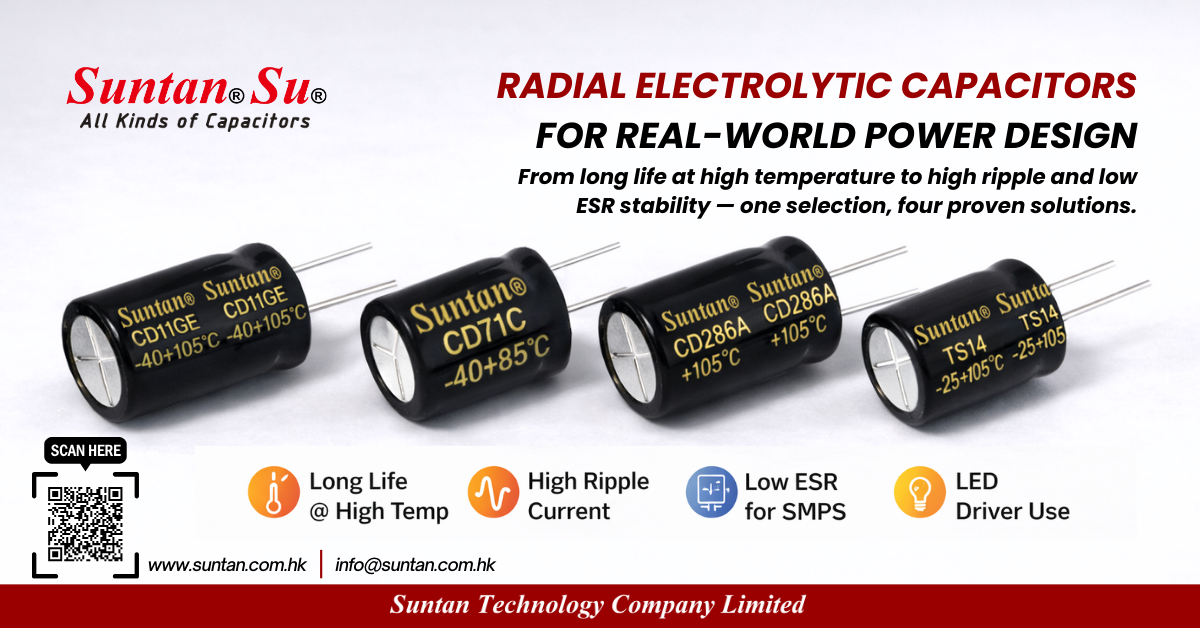
Long life vs standard radial electrolytic capacitors influences power supply lifetime, SMPS output stability, and LED driver reliability. Engineers evaluating an aluminum electrolytic capacitor must consider endurance hours, temperature rise, and ripple current stress together, as these factors define real operating life.
Understanding Electrolytic Capacitor Endurance Ratings
The endurance rating (2000h, 5000h, 10000h) indicates how long the capacitor maintains electrical characteristics at rated temperature and ripple current. As electrolyte evaporates over time, ESR increases and capacitance decreases, leading to ripple voltage rise and potential instability.
| Class | Endurance @105°C | Typical Usage | Expected Duty |
|---|---|---|---|
| Standard | 2000h | General electronics | Intermittent |
| Long Life | 5000h | LED drivers / controls | Extended use |
| High Endurance | 10000h | SMPS / telecom | Continuous |
Temperature Acceleration Model
Electrolytic capacitor lifetime follows temperature acceleration behavior. Life approximately doubles for each 10°C drop in core temperature. Ripple current heating raises internal temperature above ambient, shortening effective endurance.
Lifetime estimation relationship:
L₂ = L₁ × 2((T₁ − T₂)/10)
Ripple Current Influence
Ripple current flowing through ESR generates internal heat (I²R loss). As ESR increases with aging, heating rises further, accelerating electrolyte dry-out in a feedback mechanism. This explains why SMPS output capacitors and LED driver capacitors require higher endurance classes.
Design Stage Selection Strategy
Engineers should base selection on:
- RMS ripple current
- Ambient and PCB thermal zones
- Expected service life
- Enclosure airflow
Field Failure Symptoms of Underrated Capacitors
When standard endurance capacitors are used in high ripple or high temperature environments, typical field symptoms appear gradually rather than as sudden failure.
- Output ripple voltage increase
- LED driver flicker over time
- SMPS regulation instability
- Rising ESR detected in maintenance testing
- Reduced hold-up time in power supplies
These behaviors are wear-out mechanisms caused by electrolyte dry-out, not dielectric breakdown. Selecting long life capacitors prevents these progressive degradation issues.
Engineering Comparison
| Parameter | 2000h | 5000h | 10000h |
|---|---|---|---|
| Electrolyte stability | Baseline | Improved | Enhanced |
| ESR drift | Faster | Slower | Minimal |
| Failure risk | Higher | Moderate | Lowest |
Official radial electrolytic capacitor endurance specifications available here.
Electrolytic capacitor endurance and temperature acceleration behavior are based on established reliability models used in power electronics design practice.
No comments:
Post a Comment